

After navigating a prolonged period of political uncertainty post July Uprising of 2024, Bangladesh has embarked afresh on an economic journey under an elected government. On 11 June 2026, Finance Minister Amir Khosru Mahmud Chowdhury presented a Tk. 9.38 lakh crore budget for FY 2026-2027 before the parliament- the largest in the country’s history. The BNP-led government has adopted a “3R” strategy: recovery & stabilisation, restoration and reconstruction, for accelerating economic growth. Whilst the scale of the budget alone has already made headlines, executing such a humongous spending plan raises serious questions, given that the state has chronically struggled to do so in the past.
Key Figures at a Glance
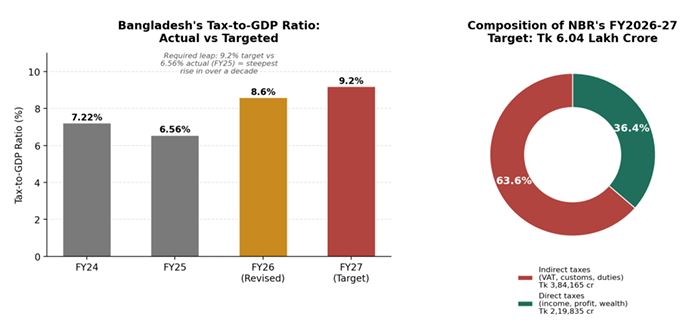
Prior to assessing the credibility of the proposed budget, it is worthwhile to lay out what it targets. Before anything else, the ambition of increasing total revenue by 23.2 per cent in a single year — a figure that Bangladesh’s tax administration has essentially never achieved — raises the first major concern. The second concern is the target for the tax-to-GDP ratio, which is projected to jump by more than two-and-a-half percentage points from 6.56 per cent (FY 2025-26) to 9.2 per cent in FY 2026-27.
The Persistent Gap Between Revenue and Expenditure
The government has handed over a whopping target of TK. 6.04 crore to the National Board of Revenue (NBR) to be collected through direct (income, profit, wealth) and indirect taxes (VAT, customs duties, supplementary duties and import duties, etc.). Yet, a careful observation of the composition of expected revenue collection, of which only 36.4 per cent comes from direct sources and the rest from indirect sources, implies that, regardless of their income level, ordinary citizens still have to disproportionately bear the burden of a regressive revenue collection system.
Whilst the revenue target is the least convincing part of the proposed budget, the expenditure side provides a promising story, at least in intent. In conformity with the election manifesto, several sectors, such as social protection, education, and health, have received the largest allocations. The single largest proportional jump in allocation, at 95.6 per cent year-on-year, is for the health sector, amounting to Tk 69,409 crore. By reversing the trend of shrinking outlay in recent years, the proposed budget has allocated Tk 136,606 crore to the education sector, equivalent to 2 per cent of GDP. About 15 per cent of the total budget, amounting to Tk 144,338 crore, is allocated to the social safety net programme. Conversely, with a year-on-year growth of approximately 6.4 per cent, allocation for the physical infrastructure sector is the lowest among the major sectors. Taking into consideration the spending plan, it is imperative that the proposed budget marks a shift in the government’s vision away from physical infrastructure to human capital development and a journey towards a democratic, humane and inclusive economy.
The Structural Fault Lines to be Cautioned About
Beyond the numbers, three structural fault lines loom over the FY2026-27 budget that no single fiscal year can resolve.
1. LDC Graduation
About five decades after its inclusion in the group in December 1975, Bangladesh is scheduled to graduate from the Least Developed Countries (LDCs) category on 24 November 2026. While this is a major milestone in Bangladesh’s journey towards a sustainable development trajectory, the graduation will phase out preferential tariff access, duty-free and quota-free market entry, and various policy flexibilities on which the economy has relied for decades.
However, Bangladesh has sought to delay the transition until 2029, citing domestic (gap in preparedness, lower implementation of core reforms, vulnerabilities in the financial sector, weaknesses in the banking system) and external economic pressures (volatility in global supply chains and import costs for fossil fuels emerging from the US-Israel war on Iran). A deeper scrutiny of the budget indicates that by choosing incremental tariff management over deep, WTO-compliant structural overhauls, the budget protects uncompetitive local industries at the direct expense of global integration and export diversification. 2. Fragile Banking Sector
The vulnerability of the banking system is the least addressed aspect in the FY2026-27 budget. While the budget attempts an expansionary development push, a concrete roadmap to restore the banking sector's foundations to support that push is missing. The government’s plan to infuse Tk 40,000 crore in liquidity into banks burdened by skyrocketing Non-Performing Loans (NPLs) will merely keep insolvent entities on life support without correcting the underlying governance or default-recovery framework. But this conflicts with the IMF's demands for stringent structural reforms. Apart from that, the fiscal strategy of covering state deficits through bank borrowing rather than developing a long-term bond market risks hitting a hard ceiling.
3. The Growth-Inflation Balancing Act
Recognizing the burgeoning macroeconomic distress, the proposed budget aims to clear initial hurdles but stumbles in charting an unrealistic and deeply contested path toward its mediumterm goals. To curb rising inflationary pressure, the government aims for a 7.5% inflation cap, which naturally requires pursuing restrictive monetary policy. Paradoxically, the conservative monetary policy stance will suppress the government’s lofty growth goals. The proposed budget seems oblivious to the need to chart a practical path to balance inflation and economic growth.
Key Takeaways for the Consulting Industry
For firms that are often hired to plan, appraise, safeguard and audit projects, what exactly is the proposed budget offer? The FY2026-27 budget offers the best pipeline of new mandates in years for consultancy companies working in the domains of environmental compliance, social safeguards, and financial or economic feasibility. Concomitantly, the budget conveys a sharp reminder of how exposed that pipeline is to Bangladesh’s chronic implementation and execution problems. At the policy level, the apex body of the National Economic Council has approved more than 1,200 new development projects, along with 80 Public-Private Partnership (PPP) projects and 148 projects under the Bangladesh Climate Change Trust Fund (BCCTF) for FY2026-27. In principle, each of these projects must pass through the Planning Commission’s approval mechanism, which relies on evidential documents such as the Development Project Proforma (DPP), Technical Assistance Project Proforma (TPP) or Technical Assistance Package Proforma (TAPP), sectoral appraisal, and Project Evaluation Committee review. Rather than producing these documents in-house, the existing framework requires the commissioning of economic and financial viability studies, cost-benefit and internal rate of return analyses, and environmental and social due diligence from external consultants through a competitive bidding process.
The financing modalities to implement these projects also offer another window of opportunity for the consulting industry. External financing for 52.8 per cent of the Annual Development Programme (ADP) implies that a growing share of new projects will require the involvement of multilateral or bilateral agencies such as the World Bank, the Asian Development Bank (ADB), and the Japan International Cooperation Agency (JICA). These agencies have their own safeguard policies for disbursement, typically requiring an Environmental and Social Impact Assessment (ESIA) or Environmental and Social Management Framework prepared to international methodological standards. This is where the budget's foreign-financing tilt turns into a real fee-earning opportunity for consultancy firms in Bangladesh.
However, chronic under-execution of ADP provides a cautionary tale for the consulting industry, which needs to equip itself with front-end feasibility work, more realistic DPP costing, and better monitoring and evaluation skills.
The real evaluation of the FY2026-27 budget doesn’t rely on its articulation and coverage but on the performance of NBR's monthly revenue collection figures, in ADP disbursement rates tracked quarter by quarter, in whether the promised digitalization of VAT and tax administration survives contact with entrenched interests, and in whether “zombie projects” are finally retired rather than rolled over. In a nutshell, the success of the proposed budget depends on whether it delivers outcomes that citizens can actually feel in their day-to-day lives.
Share this page via