

Dhaka’s rapid growth has transformed it into one of the world’s busiest and most densely populated megacities. New buildings, roads, industries, and residential areas continue to expand across the city. But while most of this development is visible above ground, a serious environmental problem is unfolding beneath the surface: Dhaka’s groundwater level is steadily declining. For decades, groundwater has been one of the city’s most dependable sources of water for households, industries, businesses, and public services. However, the growing demand for water, combined with excessive extraction and declining opportunities for natural recharge, is placing increasing pressure on Dhaka’s aquifer system. Because groundwater depletion happens underground, it often receives less public attention than flooding, air pollution, or traffic congestion. Yet its long-term consequences could be equally serious, particularly for Dhaka’s future water security and environmental sustainability.
Dhaka’s Dependence on Groundwater
Dhaka is located within the Bengal Delta, a region formed by thick deposits of sand, silt, and clay. These sedimentary layers contain extensive aquifer systems capable of storing and transmitting groundwater. Historically, groundwater has supplied a major share of Dhaka’s municipal water demand. Dhaka Water Supply and Sewerage Authority (DWASA) has relied heavily on deep tube wells to meet the needs of the growing city, although efforts are now being made to increase the use of treated surface water. The problem is that Dhaka’s population, industries, commercial activities, and urban infrastructure have grown much faster than the aquifer’s ability to naturally replenish itself in many areas. In simple terms, water is being withdrawn from the ground faster than nature can replace it. Groundwater depletion in Dhaka has become one of the clearest environmental consequences of rapid urban growth. Studies have reported groundwater-level declines of approximately 0.6 to 2.4 metres per year in different parts of the city. The rate is not the same everywhere. Central and heavily urbanized areas generally experience greater decline because groundwater extraction is high while natural recharge is limited. Research on Dhaka’s aquifer system has also recorded significant drops in groundwater levels. In some deep aquifers, water levels reportedly declined from around 54 metres below ground level to more than 66 metres, representing a fall of almost 12 metres within the observation period. The longer-term trend is even more concerning. Groundwater that was once available only a few metres below the surface is now found at much greater depths in many parts of Dhaka. Recent observations based on Bangladesh Water Development Board (BWDB) monitoring indicate that groundwater levels have reached approximately 70–75 metres below ground level in some locations. The decline has been particularly noticeable in highly urbanized areas such as: Motijheel, Dhanmondi, Mirpur, Ramna, Hazaribagh, Tejgaon. These locations combine intensive water demand with dense construction and limited open land for natural recharge.
Why Is Dhaka Losing Groundwater?
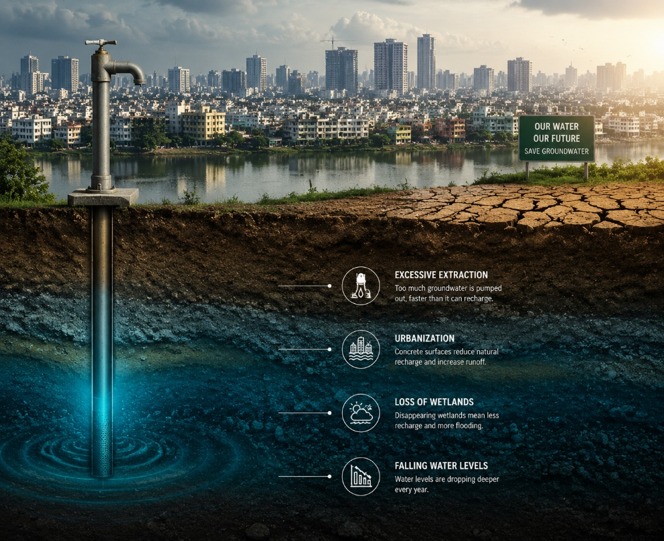
Excessive Groundwater Extraction: Too much groundwater is being pumped out. When pumping continues faster than recharge, groundwater levels begin to fall. Intensive pumping can also create what hydrogeologists call a cone of depression, a lowered groundwater surface around major pumping areas.
Rapid Urbanization and Reduced Recharge: Open soil and natural surfaces have increasingly been replaced by buildings, roads, parking areas, pavements, and other concrete structures. These surfaces do not allow water to infiltrate easily. Instead, rainfall quickly becomes surface runoff and enters drains, canals, or low-lying areas.
Loss of Wetlands and Natural Drainage Systems: The reduction of wetlands can therefore contribute both to increased urban flooding and reduced groundwater recharge. When wetlands disappear, the city loses more than open space. It also loses an important part of its natural water-management system.
What Could Happen If Groundwater Depletion Continues?
“When the well is dry, we know the worth of water.”
-Benjamin Franklin
1. Higher Water Extraction Costs: As groundwater levels fall, wells must be drilled deeper and pumps must work harder to lift water to the surface. This means greater energy consumption, higher operational costs, and additional investment in water-supply infrastructure.
2. Greater Pressure on Water Security: A steadily declining groundwater table raises an important question: how dependable will this resource remain in the future? If extraction continues without sufficient recharge, maintaining the same level of groundwater supply may become increasingly difficult, particularly during dry periods or periods of high demand.
3. Potential Risk of Land Subsidence: Groundwater fills spaces within underground sediments and helps maintain pore-water pressure. Excessive withdrawal can, under certain geological conditions, cause sediments to compact. This process may contribute to land subsidence, or the gradual sinking of the ground surface. The extent of this risk depends on local geology and requires detailed investigation, but it is an important consideration for a densely built city such as Dhaka.
4. Challenges for Sustainable Urban Development: Groundwater depletion is closely connected to broader questions of urban sustainability. A city cannot continue expanding indefinitely while depending heavily on a water source that is being depleted. As groundwater becomes more difficult and expensive to access, pressure increases on surface-water treatment plants, pipelines, reservoirs, and other alternative water-supply systems.
What Can Be Done?
There is no single solution to Dhaka’s groundwater problem. Sustainable management requires cooperation between engineers, geologists, urban planners, environmental specialists, policymakers, industries, and communities. Why Geology Matters? Groundwater depletion is not simply a water-supply issue. It is also incorporation of geological and hydrogeological issue into sustainable water management.
1. Increase the Use of Surface Water
One of the most important long-term strategies is to gradually reduce excessive dependence on groundwater. Expanding reliable, treated surface-water systems can reduce pressure on Dhaka’s aquifers. DWASA has already been moving in this direction through major surface-water supply projects.
2. Protect Recharge Areas & Promote Rainwater Harvesting and Artificial Recharge
Remaining wetlands, open spaces, floodplains, and natural drainage areas should be considered important parts of Dhaka’s water infrastructure. Protecting these areas can help rainfall infiltrate into the ground rather than immediately becoming surface runoff. Urban development plans should therefore consider groundwater recharge alongside drainage, flood management, and land-use planning.
The relationship is straightforward:
More concrete surfaces → less infiltration → lower groundwater recharge → faster groundwater decline
This is why urban planning and groundwater management cannot be treated as separate issues.
Again, Dhaka receives significant rainfall during the monsoon, but much of it is rapidly discharged as runoff. Rainwater harvesting can capture part of this water for domestic or non-potable uses, reducing demand on groundwater. Where geological conditions are suitable, managed aquifer recharge or artificial recharge systems may also allow collected rainwater to be directed underground. Such projects, however, require careful hydrogeological assessment to avoid groundwater contamination.
3. Include Hydrogeological Assessments in Development Projects
Groundwater should be considered during the planning stages of major industrial, commercial, infrastructure, and urban-development projects. Environmental Impact Assessments (EIA), Environmental and Social Impact Assessments (ESIA), and feasibility studies should examine issues such as groundwater availability, abstraction requirements, aquifer characteristics, potential recharge impacts, and groundwater quality. This is particularly important for developments that depend on large volumes of groundwater or cover extensive areas with impermeable surfaces. By strengthen groundwater monitoring network such as groundwater levels, extraction rates, seasonal fluctuations, water quality, recharge patterns, long-term aquifer behavior can help identify critical depletion zones and support evidence-based decisions on groundwater abstraction.
Dhaka’s groundwater crisis is easy to overlook because most people cannot see it happening. There is no dramatic visual warning when the groundwater table falls another metre. Ultimately, Dhaka’s future water security depends not only on how the city develops above the ground, but also on how carefully it manages the resources hidden beneath it. Understanding what lies beneath the surface is essential for building a sustainable city above it.
Share this page via